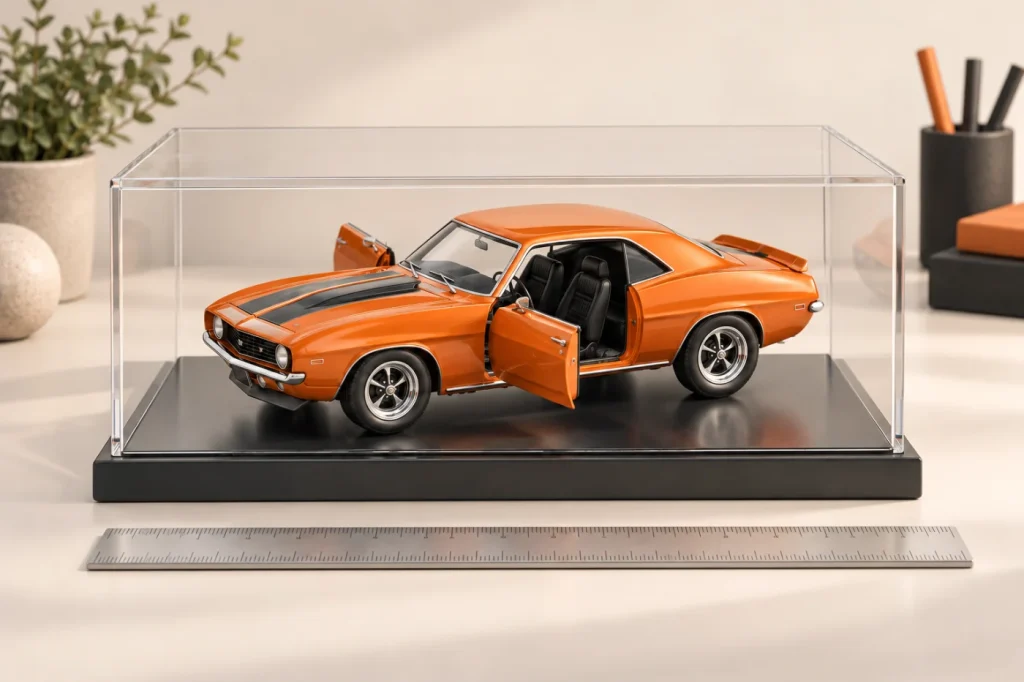
Measure the usable space inside the case against the car in its intended display pose. A case labeled “1:18” does not tell you whether the mirrors, raised hood or open doors will fit. For a model you already own, a ruler and a paper layout are more useful than a scale label.
First decide what the case must hold
Choose a closed-car display, an open-panel display, or a car kept on its original base. Include anything that will share the enclosure, such as a nameplate or figure. These are different space requirements; measuring the car alone will not settle all three.
| Display choice | Measure this | Common oversight |
|---|---|---|
| All panels closed | Overall length, widest point and highest point | Mirrors or a rear wing extend beyond the main body |
| Doors or hood open | The full width and height in the chosen pose | The closed-car dimensions leave no opening clearance |
| Original display base retained | Base footprint and total mounted height | The base is larger than the model |
Measure the usable interior, not the outer box
- Record internal length, depth and height. If shopping online, check whether each published dimension describes the interior or exterior. Ask the case seller when the listing is ambiguous.
- Check the narrowest usable space. A lip, frame, shelf support or raised base can reduce the area where the model actually sits.
- Account for access. With a lift-off cover, consider the cover’s path past mirrors and raised panels. With a front door, check the opening through which the model must pass.
- Write all measurements in the same unit. Convert before comparing; do not mix inches and centimeters in the subtraction.
Measure the model without forcing its parts
Place the car on a stable surface and measure to its outermost points. Follow its supplied opening instructions. If a panel resists or the documentation does not identify it as opening, stop; this guide is not an instruction to pry it open.
For an open display, measure the model after placing its documented opening parts in the desired positions. There is no universal “add two inches” allowance: door length, opening angle and hinge layout vary. If you cannot measure the open pose before purchase, ask for those dimensions or treat fit as unresolved.
Use subtraction to check clearance
For each axis, subtract the model’s occupied size from the case’s usable internal size. A negative result means it cannot fit in that orientation. Zero leaves no clearance. A positive result still needs enough room for placement, removal and the intended display pose.
For a real catalog reference, the merchant lists the white Maisto GT500 at approximately 10 × 4.75 × 3 inches. Its measurement method and open-panel envelope are not specified. Use those figures for initial screening, then confirm the dimensions needed for your display; they are not a case-fit guarantee.
Test the layout before ordering
Draw the case’s usable footprint on paper and mark the model’s occupied rectangle inside it. Include the base and accessories. A side-view sketch helps check height. If displaying diagonally, lay out that actual angle: rotating the car changes the width and depth it occupies, so the straight-ahead figures no longer answer the question.
Finish with four recorded answers: usable case dimensions, model dimensions in the chosen pose, remaining clearance on each axis, and a clear path for putting the model in and taking it out. If any answer is missing, resolve it before treating the case as compatible.