AUTOart 71279 Corvette C7 ZR1 review: stronger outside than under the hood
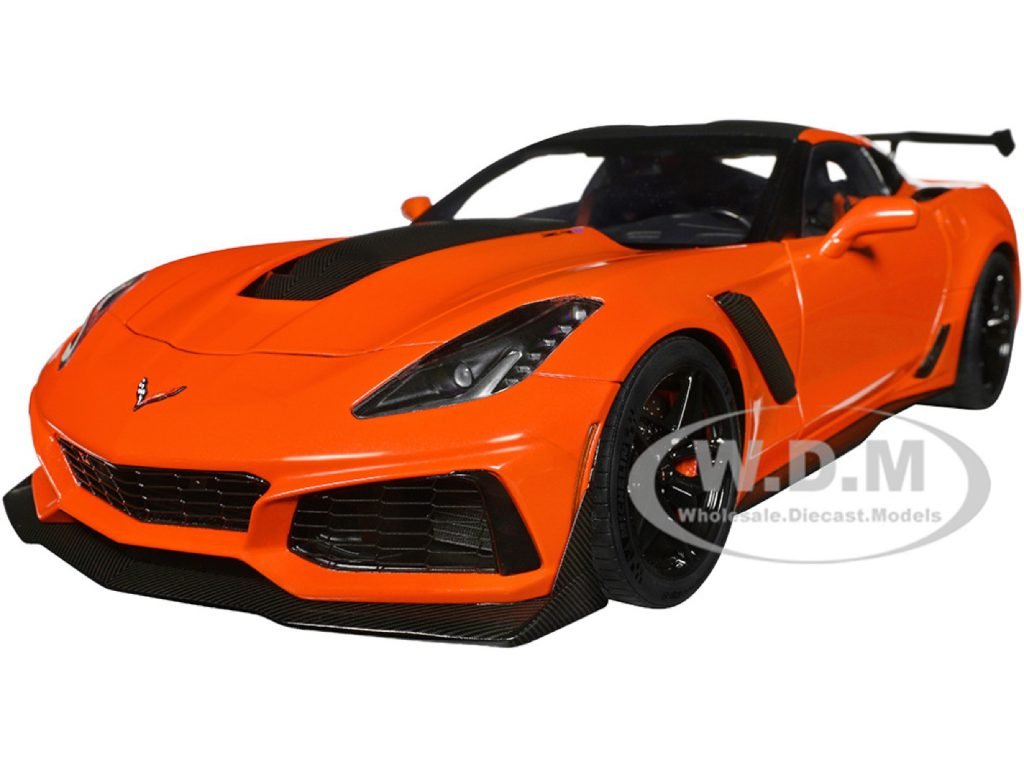
An orange C7 ZR1 with convincing paint, panel fit and front mesh; the engine bay and cabin textures are less elaborate than its exterior.
At a Glance
Model essentials
- AUTOart 71279 · 1:18 C7 ZR1
- Sebring Orange Tintcoat · carbon-top version
- Opening hood, doors and rear storage
- Approximate catalog size: 10 × 4.5 × 3.5 in
Collection highlights
- Consistent paint and close panel gaps
- Perforated front openings
- Flocked rear storage with paired struts
- Orange cabin belts with metal buckles
Before you choose
- Engine detail is comparatively sparse
- Rear-side vents are solid
- Dashboard and door-card textures are plain
Available from Diecast Models Wholesale
View model at retailer ↗Price and availability subject to change
On the Sebring Orange C7 ZR1, the quality of the view changes as you move around the car. The front grilles have real openings, the rear bumper vents do not, and the consistent paint ties the closed panels together. That uneven distribution of detail is more useful to understand than a total of opening parts.
Front mesh versus solid rear vents
The inspection of the matching orange configuration found perforated openings at the front but solid plastic vents beside the rear bumper and outer lamps. For a display angled toward the nose, the mesh gives the openings depth. A rear-facing close view exposes the different treatment. The inspection also judged the splitter’s side sections undersized, so the appealing nose is not an unqualified accuracy endorsement.
What changes when the hood stays up?
The prominent scoop remains the engine compartment’s main feature. Supporting detail is sparse and the radiator is not represented. Leaving the hood raised therefore brings a weaker area into the foreground rather than revealing a hidden highlight.
A more rewarding opening
The rear storage area has flocking and a supporting strut on each side. It offers a finished compartment to examine without making the sparse engine bay the centerpiece.
Cabin contrast
Orange belts and metal buckles stand out against the cabin. The dashboard and door-card textures are less developed, so the small hardware is more persuasive than the surfaces around it.
The inspected openings operated smoothly and the closed panel gaps were close. Those observations explain why a primarily closed display is convincing without implying that every opening contains equally elaborate detail. The source photographs match this orange, carbon-top configuration; they do not establish finish quality for other C7 colors.
Pros & Cons Analysis
See the source attributions and review limitations below.
Pros
- The inspected panels matched in color despite opening separately. That helps a closed-body display retain the continuous orange shape instead of drawing attention to the joints.
- Actual openings at the front provide depth around the nose. The benefit is location-specific: it does not describe the solid vents at the rear.
- Flocking and two supporting struts make the rear compartment worth opening independently of the hood. The interior also gains fabric-effect flooring and distinct belt hardware.
Cons
- The missing radiator and simplified surrounding engine components limit what can be studied beneath the hood. Smooth access should not be read as a promise of intricate mechanical reproduction.
- The dashboard and door cards do not carry the same texture distinction as the belts and flooring. An open-door display exposes that unevenness rather than resolving it.
- The inspection found the side sections of the chin splitter small relative to the represented car. This is a shape-accuracy reservation, separate from its favorable assessment of paint and panel fit.
Let the orange body lead the display
The front mesh, consistent paint and close panel gaps make the closed Sebring Orange C7 the convincing presentation. The flocked rear storage is the more rewarding opening to add. A permanently raised hood would instead emphasize sparse supporting engine detail and the missing radiator.
Frequently Asked Questions
Does the carbon top mean this is made from real carbon fiber?
No such construction is established. The inspection describes a composite model with a carbon-fiber pattern applied as a finish. The carbon-top wording identifies the depicted version; it is not proof of real carbon-fiber panels in the miniature.
Technical Specifications
| Brand | AUTOart |
|---|---|
| Product code | 71279 |
| Subject | 2019 Chevrolet Corvette C7 ZR1 |
| Edition / version | Carbon-top version |
| Color / livery | Sebring Orange Tintcoat |
| Scale | 1:18 |
| Model type | Road car |
| Materials | Composite body — independent inspection |
| Length | 10 in |
| Width | 4.5 in |
| Height | 3.5 in |
| Measurement basis | Approximate catalog dimensions; pose unspecified |
| Opening panels | Hood; doors; rear storage hatch |
| Moving parts | Steerable wheels — merchant listing |
| Lighting | Unknown |
| Power source | Unknown |
| Included figures | Unknown |
| Included equipment | Unknown |
| Display base | Unknown |