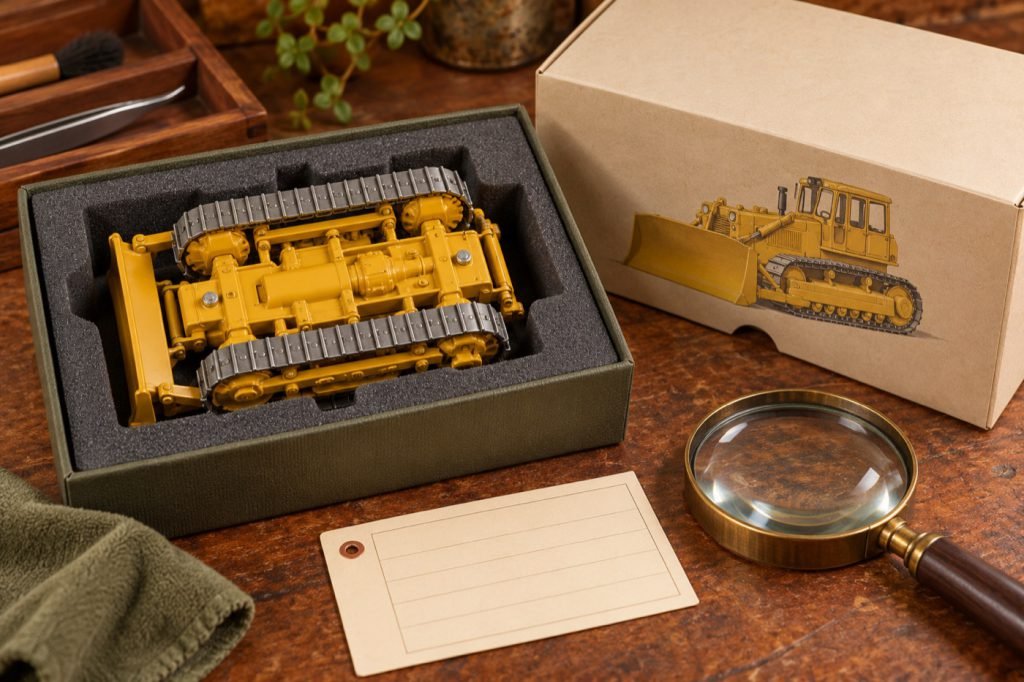
A number molded into a diecast chassis and the number on its retail box can serve different identification roles. Record both before deciding that a mismatch proves the wrong model. Equally, do not assume that every mismatch is harmless.
Build an identity record in layers
| Layer | Record |
|---|---|
| Retail release | Box label, barcode and stated product code |
| Miniature | Visible subject, livery, fitted equipment and scale |
| Underside | Cast-in and applied numbers photographed separately |
| Offer | Seller’s exact title, contents and item photographs |
The D11 Fusion 85604 is a documented example of an older 85565 cast number alongside the newer release graphic. The D10 85711 inspection likewise records an earlier underside identity. These examples show why a cast number cannot always settle a retail-release question by itself.
Follow the disagreement
- Box and model agree, but a cast number differs: look for documentation for that exact release before declaring a mismatch.
- Box and visible model disagree: ask the seller to identify the actual item; do not let the box stand in for the miniature.
- Only a stock image is available: the identity of the offered example remains unresolved.
Keep uncertainty in the record. A reused mold is not a universal explanation for every unexpected number, and this process is not a counterfeit-authentication test. It is a way to avoid discarding useful evidence or inventing a production history.
End with a precise description
If the unresolved detail is essential to the purchase—an attachment, edition or package contents—wait for evidence that settles that point. A tidy product title is less useful than an accurate identity record.