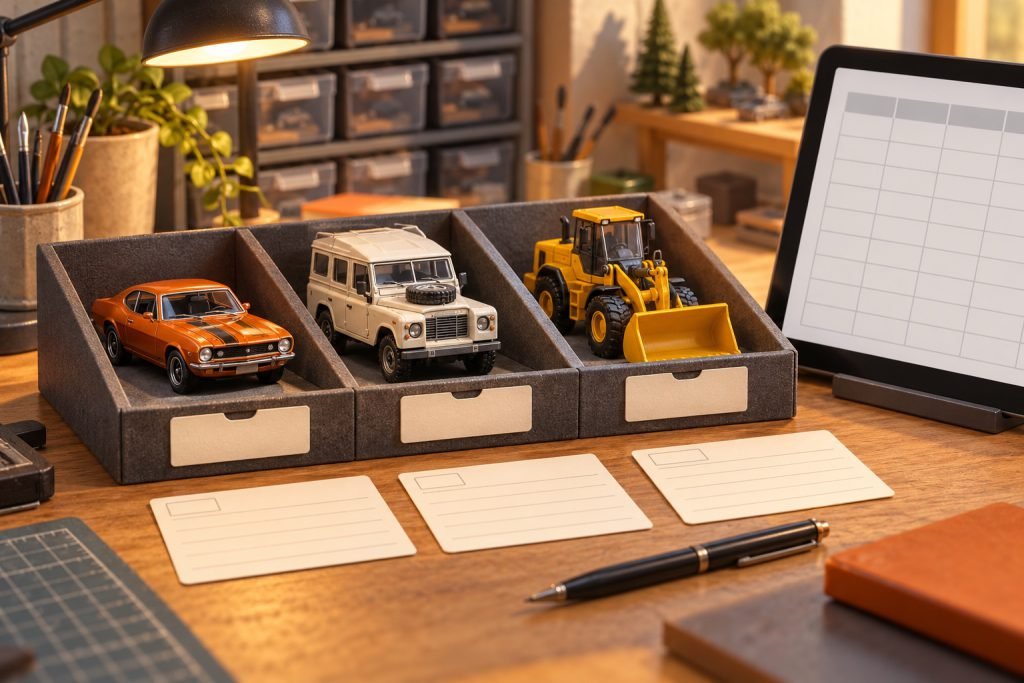
Give each physical model its own inventory entry and keep the manufacturer’s product number separate from a seller’s stock code. This makes accessories, photographs and purchase records easier to match later.
Use identity fields that survive a store rename
Record maker, manufacturer product number, represented machine, scale, finish and attachment package. Add the merchant SKU in a separate field. Do not rely on a short name such as “CAT excavator”: several distinct miniatures can share it. For a multi-model set, record the set code and the pieces actually present.
Separate the catalog description from your example
Keep official or merchant claims in a source column with a dated link. Record your own example’s missing parts, repairs, box condition and observations separately. The 972M bucket model, for example, should not inherit a log-fork package simply because another 972M listing includes one.
Link accessories instead of guessing later
Bag or box loose accessories with an inventory label. Record their supplied quantity and the model they belong to. Keep a copy of instructions where permitted. If compatibility with another model has not been established, write “unverified” rather than linking it as an interchangeable part.
Make the inventory maintainable
Start with a spreadsheet or simple table you can export. Useful columns are inventory ID, maker code, scale, configuration, purchase date, condition, storage location, source URL and photo folder. Update the location when a model moves between shelf and box. Back up the file and original photographs; a perfect catalog that is never updated will quickly become misleading.
Exact-model reference: 85949 sample inspection. These examples do not establish behavior for every model.