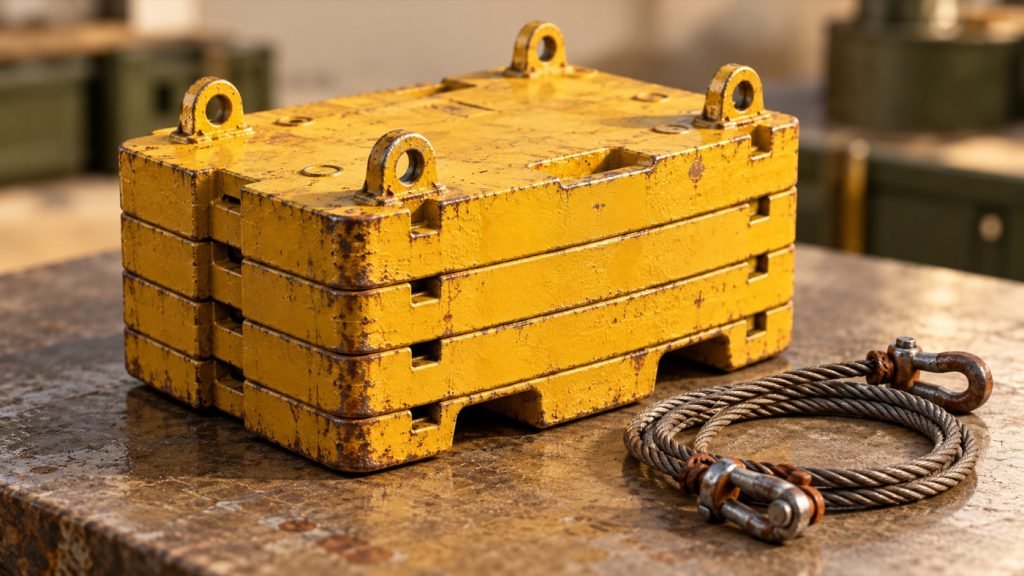
A miniature may reproduce a cable, hook or lifting eye because it is visible on the real machine. That resemblance does not establish a usable rigging point. First identify whether the feature is decoration, a movable display part or a function documented for the model.
- A solid lifting-eye shape has no opening for a connection.
- A cable shown beneath a bed may represent a service restraint rather than lifting equipment.
- A movable hook does not, by itself, establish the strength of the surrounding assembly.
The merchant describes hold-down cables beneath the 797F bed. The inspection identifies safety-cable detail, but neither statement provides a lifting rating. On the 395 GP, the counterweight lifting eyes are solid. Those are different reasons not to infer usable rigging from appearance.
Read the exact function before making a scene
For a crane-loading vignette, use a supported display arrangement that does not rely on unverified parts bearing weight. Keep the miniature supported independently and use visual rigging only where the exact model instructions permit it. Do not drill, bend or pull a decorative part to make the scene work.
If an instruction describes a restraint, preserve that function and its conditions. Do not reclassify it as a lifting point merely because the full-size machine has one nearby.