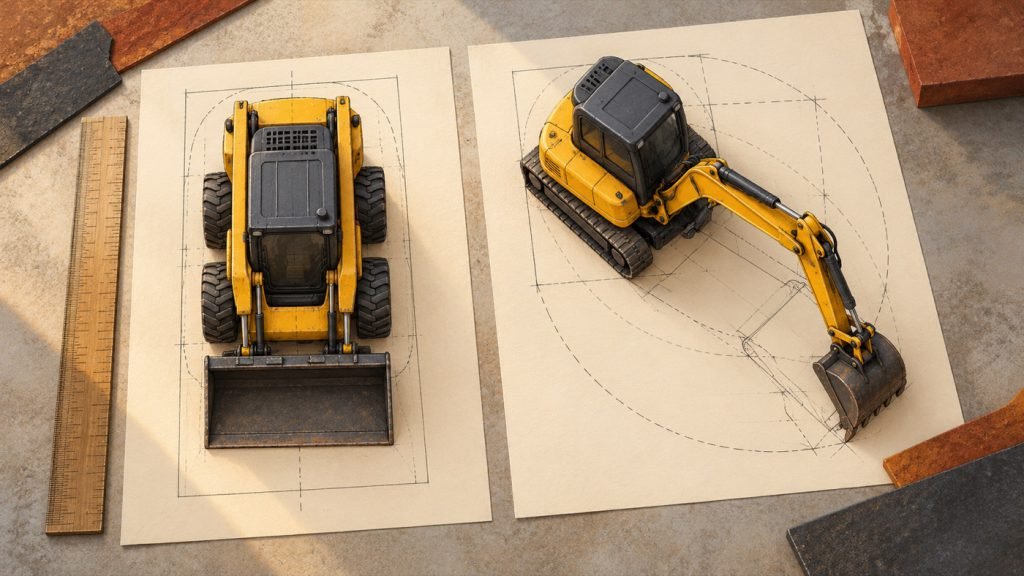
A length, width and height are useful only when you know what was measured. Before comparing two construction models, separate a catalog’s approximate dimensions from a measured display envelope, packaging size or the dimensions of the represented full-size machine.
Put the basis beside the number
| Value type | Keep with the value |
|---|---|
| Catalog miniature size | Units, source and stated pose—or “pose unspecified” |
| Measured display envelope | The exact model and chosen arm, body or steering position |
| Packaging size | An explicit packaging label |
| Full-size machine specification | An explicit real-machine label; not a miniature measurement |
The 980 and 982 XE are both listed at approximately 8 × 3 × 2.75 inches. That supports an initial size comparison. It does not prove their turned or raised envelopes match, because the listed pose is unspecified.
Keep the axis order explicit
A description may give length, height and width in that order while another uses length, width and height. Copy the labels with the numbers, then normalize the order. Do not rely on position alone. For a table, use separate Length, Width and Height rows so the labels survive a narrow mobile view.
Unknown is a useful result
If the posed dimension is not documented, retain it as unknown and obtain an actual measurement before ordering a close-fitting enclosure. Do not backfill the gap with the shipping box or a visually estimated angle. A clearly stated gap is more useful than a precise-looking but mismatched number.