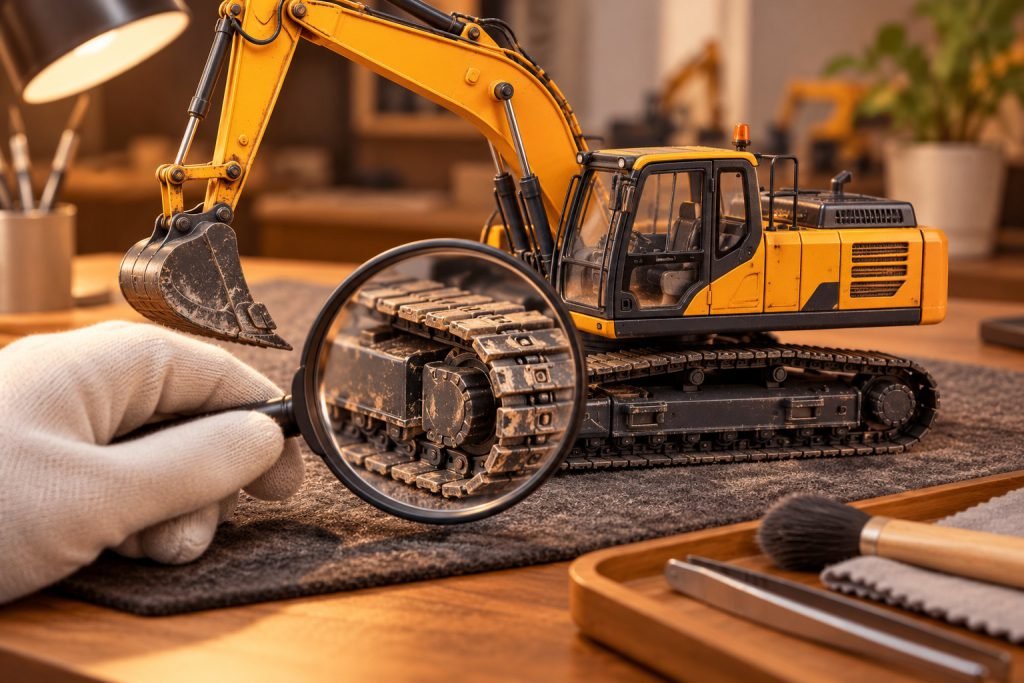
Request photographs of the exact item, its underside and all loose parts before agreeing on a used model. A catalog image establishes appearance; it does not document the condition or completeness of the item being sold.
Confirm what the sale includes
Write down the maker, product number, scale and configuration. Ask whether the box, instructions, operator, attachments and small tools are included. Separate “not supplied with this release” from “missing from this example.” The CAT 352 release reviewed here is a reminder that an empty cab is not automatically evidence of loss.
Ask for views that answer specific questions
Request both sides, front, rear, underside and one close-up of the boom or blade connections. Look for displaced tracks, bent rails, broken mirror stalks, missing pins and conspicuous paint damage. Ask the seller to identify repairs or replacement parts rather than trying to infer them from a compressed photograph. A photograph can leave a defect unresolved; it cannot prove flawless operation.
Separate appearance from movement
Ask whether documented joints hold the shown pose and whether any part binds. Request a short demonstration only within the model’s intended movement. Do not ask the seller to pry a sealed panel open or force an arm to match a real-machine picture. A nonmoving detail may be intentional, so compare it with exact documentation.
Make an accept-or-decline record
List each unresolved point with the photo or answer needed. Decide which omissions you can accept before considering the price. If a particular attachment or pose is essential, an unanswered question about it is a reason to pause. Keep the seller’s description with your purchase record so future condition checks have a baseline.
Exact-model reference: 85792 sample inspection. These examples do not establish behavior for every model.