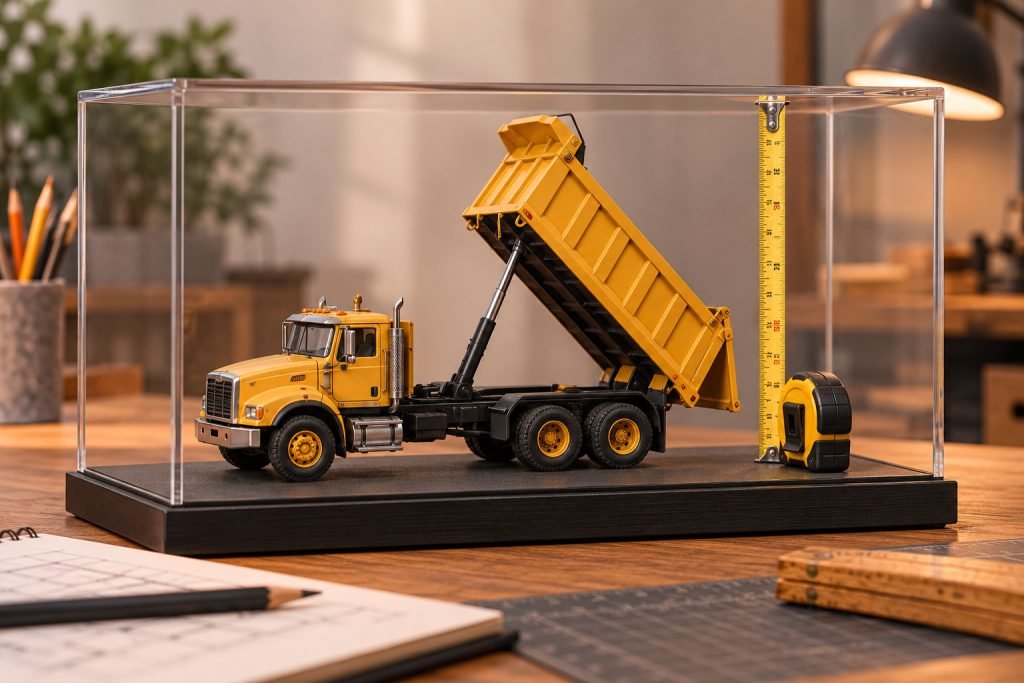
Measure the truck in the intended tipping pose. The closed-bed catalog height is not the maximum height, and a raised bed can also change the space needed behind the truck.
Choose a stable pose first
Use only a pose that the model is designed to hold. Do not wedge the bed open with an improvised load. Set articulation and steering as they will appear in the display; a turned truck occupies a different rectangle from a straight one.
Record three occupied dimensions
Measure from the supporting surface to the highest point, from the frontmost to rearmost point and across the widest part. Include a display plinth and any fixed scenery. Record the bed angle or keep a side photograph so the measurements can be reproduced. There is no universal extra-height allowance for all tipping models.
Check the route into the enclosure
A case can be large enough internally while its opening is awkward. Check how a lift-off cover passes over the raised bed, or how a front-opening case admits the model. Allow room to place and remove it without touching delicate details. Do not lift the model by the bed merely because it tips.
Keep the measurement with the model
Write the case’s usable interior dimensions beside the occupied model dimensions. A positive subtraction is only the remaining clearance, not a guarantee of convenient access. The CAT 745 has documented tipping poses, but the merchant’s listed height does not specify a raised-bed envelope. Confirm your chosen pose before ordering a case.
Exact-model reference: 85528 sample inspection. These examples do not establish behavior for every model.