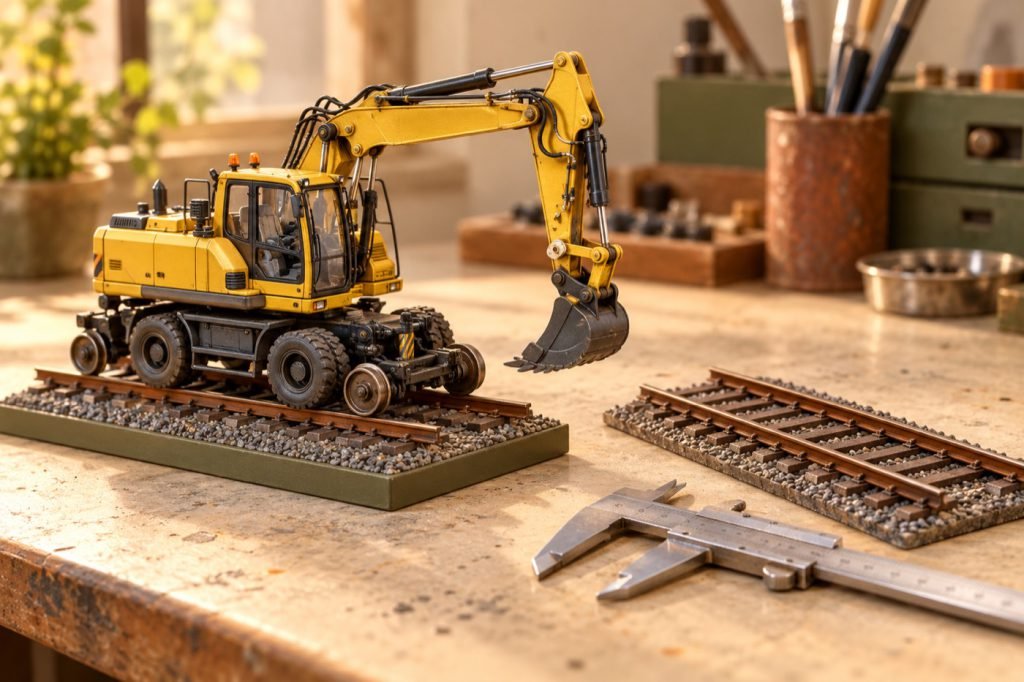
A road-rail miniature supplied with a short track base is not automatically compatible with the railway track already on your layout. The supplied base proves that a display arrangement exists; it does not identify every dimension needed for another track system.
What needs to match?
| Check | Why it matters |
|---|---|
| Rail-wheel spacing | The wheel arrangement must meet the actual rail position |
| Wheel and flange profile | Spacing alone does not settle how the wheels sit on the rail |
| Local clearances | Steps, road tires and nearby detail may interfere |
| Route geometry | A straight display section does not prove behavior on curves or points |
The M323F 85661 review retains an unverified O-gauge suggestion from its inspection. It is not a measured compatibility statement. Do not repeat that suggestion as a confirmed specification in a listing or layout plan.
Collect evidence before integrating it
Identify the exact track system and ask for measured rail-wheel spacing on the model, with a clear view of how the wheels sit on its supplied section. If direct comparison is possible, use an unpowered, removable section and the manufacturer’s normal handling directions. Do not force the wheels between rails or use a powered layout as an improvised test.
Accept a separate vignette when fit remains unknown
A short maintenance scene on the included section can sit beside a railway collection without claiming interoperability. Keep the join visually deliberate: a standalone plinth is more honest than a disguised connection that the model cannot use. Record external compatibility as unknown until evidence settles it.