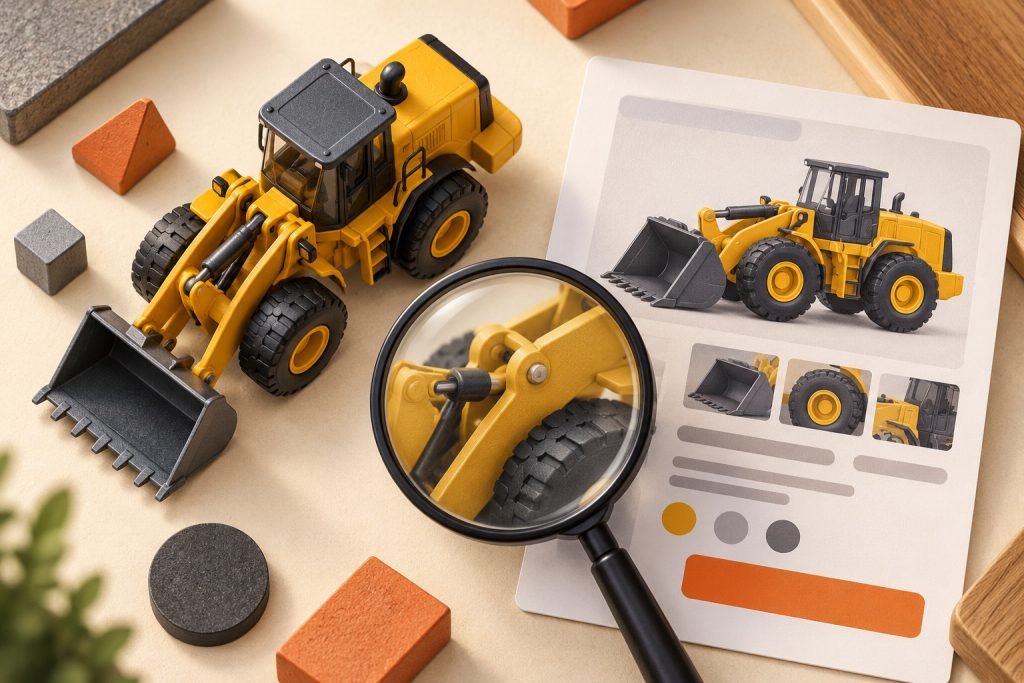
Check whether the description belongs to the pictured machine before using it to make a buying decision. Store pages can combine a correct title with copied or outdated feature bullets.
Build an identity chain
Match the title, manufacturer product number, scale, photographs and box label. One matching number is not enough if the pictured machine or attachment differs. Distinguish a merchant’s stock suffix from the maker’s own code, and keep sets or accessory bundles separate from a single model.
Look for impossible combinations
A tracked excavator description mentioning rubber tires or a grader description discussing a backhoe should prompt a check. Do not assume the remaining feature bullets are accurate. The 18M3 listing contains inconsistent backhoe terminology; the relevant model evidence describes a grader. Its uncertain dimensions are therefore not repeated as verified facts here.
Resolve discrepancies with specific questions
Ask the seller to confirm the exact code, supplied attachment and disputed feature. For dimensions, ask whether they describe the model, its pose, the display base or the shipping box. Manufacturer documentation and clear photographs may resolve identity; seller clarification is still needed for the actual package being offered.
Keep unresolved fields unresolved
Write “not verified” instead of choosing whichever value is more convenient. If a feature is essential to the purchase, wait for evidence of that exact feature. Keep the source and date of a correction with your collection record so the uncertainty is not forgotten. A plausible description is not the same as a verified one.
Exact-model reference: 85521 sample inspection. These examples do not establish behavior for every model.