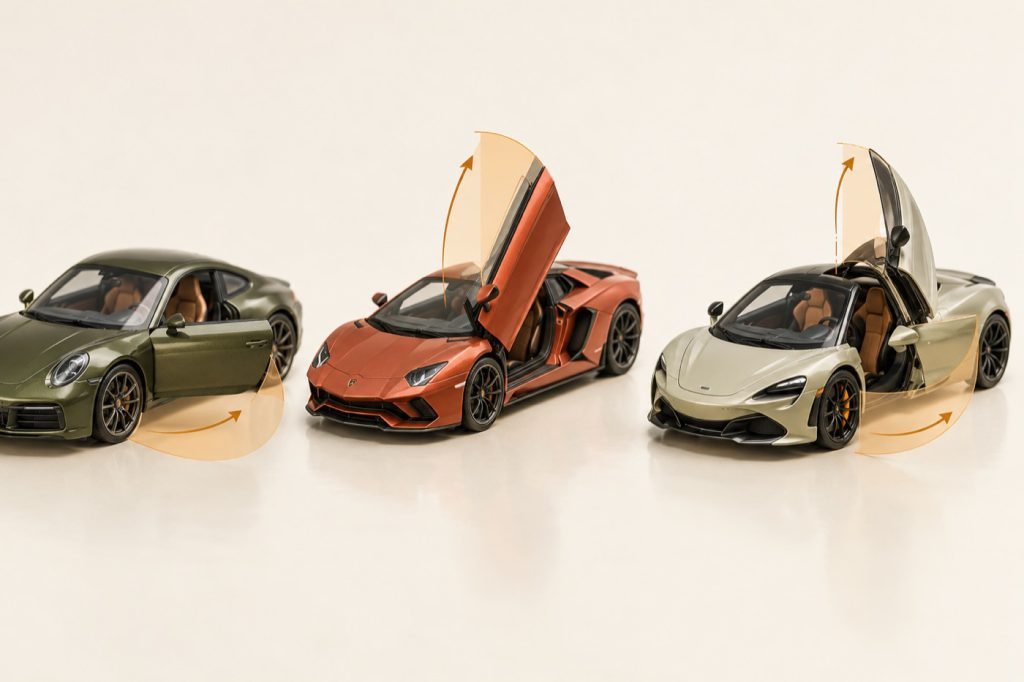
A case can fit a door’s final raised pose and still leave too little room for the door to reach it. Plan two things separately: the space occupied by the displayed model, and the path needed to open it or place it into the case already posed.
The label “opening doors” hides these differences
| Conventional roadster doors | Huayra 78286: do not substitute the coupe’s gullwing expectation. |
|---|---|
| Scissor doors | Diablo SE30 79156: rise beside the body. |
| Compound movement | Regera 79027: move outward before rotating up; windows stay fixed in the doors. |
The Huayra, Diablo and Regera inspections establish these descriptions. They do not establish the same hinge design, grip point or opening force.
Decide where the opening will happen
Pose it before placing it
Account for the widest and tallest points of the posed model and the route through the case opening. Mirrors and other projections belong inside that envelope.
Open it inside the case
The motion path needs room as well as the final pose. The Regera’s outward movement is a useful reason not to assess clearance from a photograph of fully raised doors alone.
Record the door type and measured pose in your case-planning notes. Leave dimensions unknown until established for the actual model. This guide identifies what must be measured; it does not convert a photograph into a clearance specification.