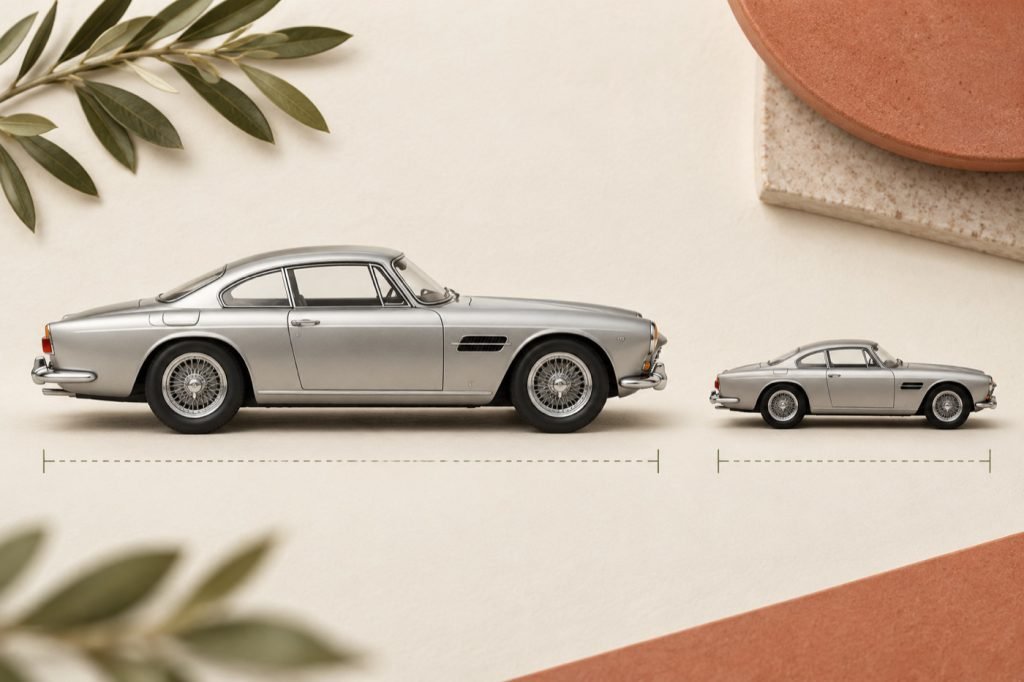
For the same car, going from 1:43 to 1:18 multiplies length by 43 ÷ 18, or about 2.39. Width also grows by that factor. A rectangular closed-model footprint therefore grows by roughly 5.71, before any clearance or base is added.
Calculate one hypothetical example
| 1:18 miniature | 180 ÷ 18 = 10 inches long; 72 ÷ 18 = 4 inches wide. |
|---|---|
| 1:43 miniature | 180 ÷ 43 ≈ 4.19 inches long; 72 ÷ 43 ≈ 1.67 inches wide. |
| Rectangular footprint | 10 × 4 = 40 square inches, versus about 4.19 × 1.67 = 7.0 square inches. |
These are mathematical examples, not measurements of a product. The calculation explains why a car a little over twice as long can demand much more shelf area.
Use the ratio only when the subject stays the same
Same vehicle, two scales
The 2.39 ratio estimates equivalent linear dimensions. Compare the same boundaries—body length with body length, not packaging with model.
Different vehicles
Use each actual miniature’s dimensions. Multiplying a 1:43 Atlantic cannot predict a 1:18 EB110, because their full-size subjects are different.
Even published dimensions can conflict. For Atlantic 50947, the inspection estimates just under 4 inches while the merchant gives approximately 4.25. A tight-case purchase needs an actual measurement, not a choice of whichever approximation fits.
Keep three space allowances outside the ratio
- A showcase or base has its own footprint.
- Doors and covers need the envelope of the intended open pose.
- Placing and removing the model requires usable clearance, not only an empty rectangle.
Scale also does not settle access: the small Atlantic has opening hood halves and doors. Choose the size for your available space, then check the exact model’s functions separately.