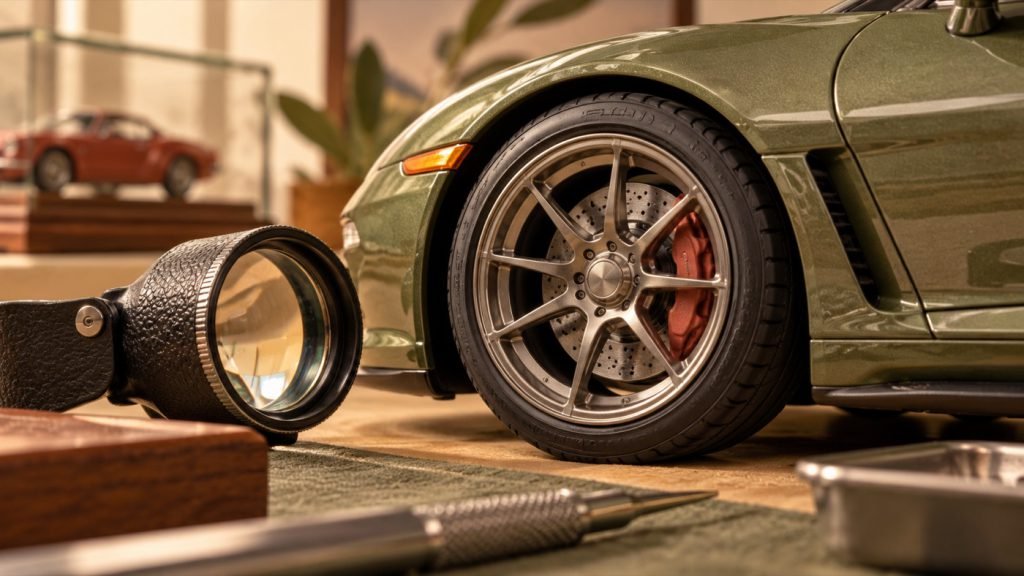
“Branded tires” is too broad to describe some miniatures accurately. On the inspected Diablo SE30, PZero lettering is present but the Pirelli name is absent. On the inspected Audi S1, Michelin graphics appear on the body while the tires themselves are unbranded. Those are different cases, and neither is captured by copying a body sponsor into the tire specification.
The Diablo account and Audi account support those specific distinctions. They are useful examples of how to read a wheel photograph without collapsing several details into one label.
Keep a four-part wheel record
| Wheel face | Pattern, center mark and visible finish. |
|---|---|
| Tire-maker name | The maker’s name actually visible on the sidewall. |
| Other sidewall text | Family name, such as PZero, or visible size/specification notation. |
| Behind the wheel | Visible brake components; leave hidden parts unconfirmed. |
Use “not visible” when the photograph cannot answer
A small or dark image may conceal black-on-black lettering. Request a sharper, oblique view of the same offered model if the marking affects your decision. Until then, “not visible in this photograph” is more accurate than “missing.”
Appearance and material also need separate records. The Audi’s white wheels looked plastic-like in its inspection; that does not identify their composition or strength. Nor does missing lettering establish a licensing explanation.
The completed record should tell you whether the wheel view meets your collecting aim. A sidewall omission may matter greatly in a wheel-focused display and little in a rear-engine display. That is a decision about emphasis, not a reason to hide the omission.