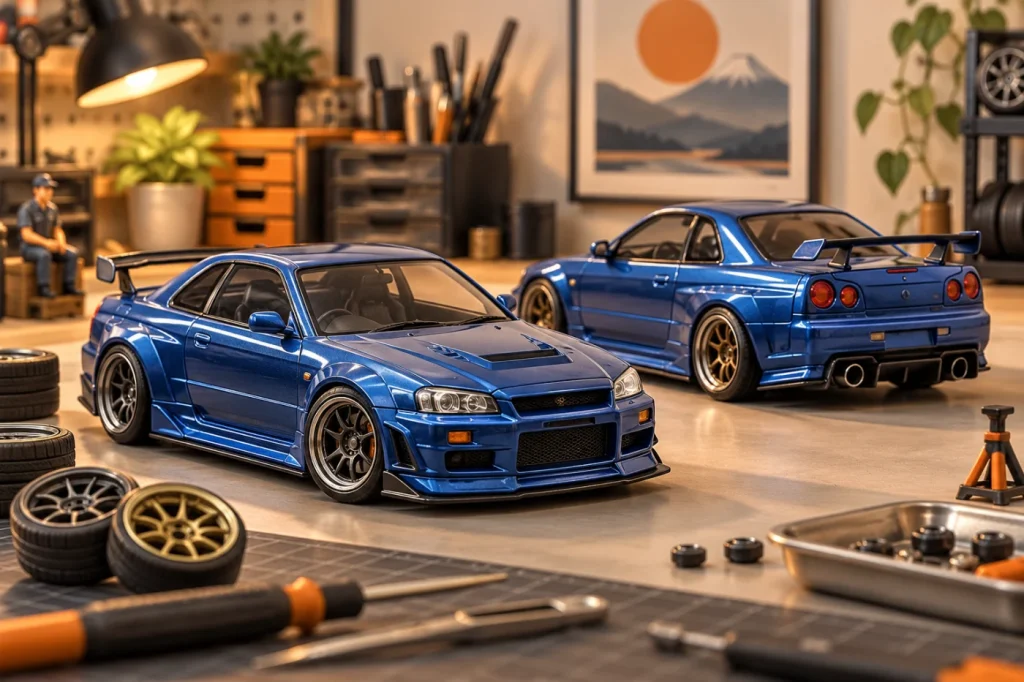
Match the complete model code and depicted specification before buying a Japanese-car miniature. “GT-R,” “RX-7” or even a matching paint color may still leave you choosing between different steering positions, body kits, wings and wheel treatments.
Read RHD and LHD from the driver’s position
RHD means right-hand drive: the steering wheel is on the driver’s right side of the car. LHD means left-hand drive. In a photograph facing the car from the front, that relationship appears reversed to the viewer. Use an interior photograph or the manufacturer’s version code instead of guessing from the picture’s left and right edges.
MINI GT’s MGT00133 listing gives a concrete example: the Martini Racing LB WORKS R35 is listed as Type 1 with Rear Wing Version 1, with separate MGT00133-L and MGT00133-R codes. Steering position and body specification are distinct parts of its identity.
Compare the kit name before comparing the wheels
Write down the exact kit or tuner wording, generation and wing version. Then compare front bumper, fender shape, rear wing and side skirts against the manufacturer’s photographs. A modified model is not necessarily trying to reproduce a standard factory road car. Judging it against the wrong reference can make an intentional feature look like an error.
The word “JDM” in a seller’s title does not, by itself, establish a particular miniature’s steering position or factory specification. Prefer an explicit version code, then resolve any conflict between the title and photographs before ordering.
Separate stance from a rolling-wheel requirement
Wheel position and ride height are visible features; free rolling is a function that needs its own evidence. Tarmac Works states that HOBBY64 prioritizes authentic ride height and that wheels may or may not roll properly. That distinction prevents a low stance from automatically becoming a promise of easy rolling.
- For a stationary display, inspect wheel centering, visible tire clearance and whether the pose matches the intended version.
- If rolling matters, look for an explicit statement for the exact release or ask the seller to confirm it.
- If a received model rubs or binds, document the issue before attempting an adjustment. A buying check is not a reason to bend axles or trim the body.
Keep a one-line identity record
Use this format: manufacturer + item code + scale + vehicle generation + steering side + kit/wing version + finish. Keep a photograph of the box label with your order record. If rarity labels also affect your choice, check what chase and event-exclusive labels establish separately; they do not replace the model’s physical identity.