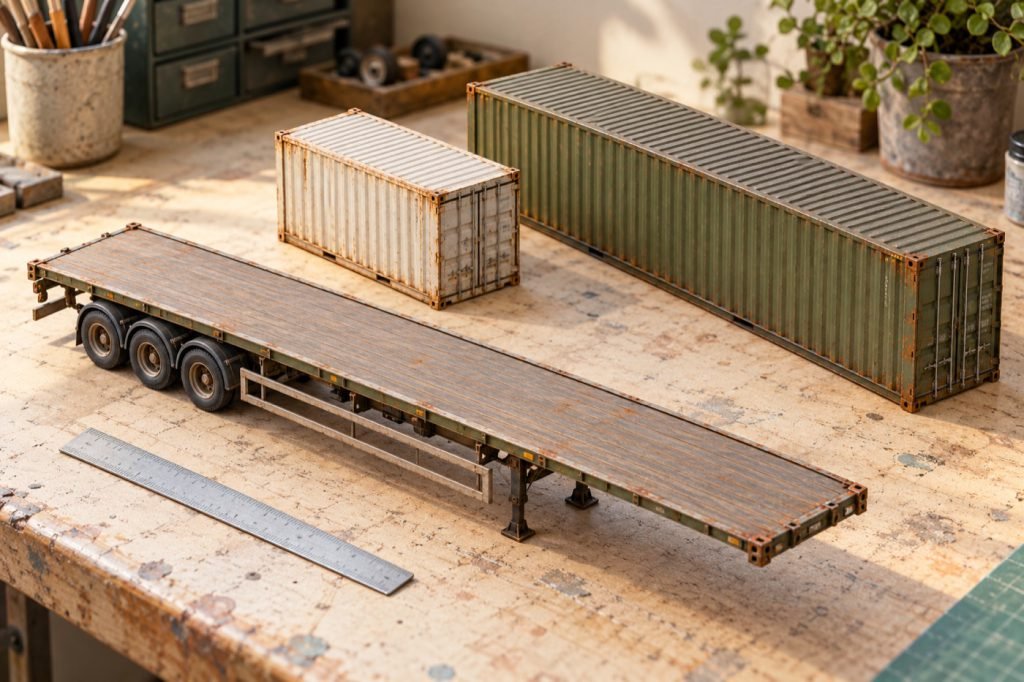
A 20-foot container can be shorter than a 40-foot trailer and still fail to mount properly. Space on the deck is only the first question. Support and fixing positions must also match the particular container and trailer.
Separate three different kinds of fit
| Fit question | Evidence to obtain |
|---|---|
| Physical space | Actual miniature length and width, with projections identified |
| Support | Where the container rests and whether those points match the trailer |
| Fixing | Matching mounting locations and the intended connection method |
The 71064 OOCL combination is a concrete example: its original inspection reports fixing points for the supplied 40-foot subject but not matching fixings at both ends of a 20-foot box. Do not turn “there is room” into “it mounts correctly.”
Ask for the two undersides
Request clear photographs of the actual container underside and the bare trailer deck, plus dimensions between the relevant supports. Keep the seller’s stated measurement units and identify the exact products in the request. A stock photograph of a nearby release cannot establish the offered mounting arrangement.
- If space, support and fixings match: retain the evidence with the pairing.
- If the box fits visually but the fixing method is undocumented: record it as unverified, not compatible.
- If a modification is proposed: treat it as a separate project, not an included feature.
Keep the terminology straight
The 20-foot or 40-foot label describes the represented full-size container. A miniature measurement belongs in inches or millimeters with its actual scale. Do not use a full-size label as though it were the model’s physical length.
Finish with a pairing record: exact container, exact trailer, supporting photographs, measured spacing and any unresolved connection detail. That is more useful for a future purchase than a generic note saying “both are 1:50.”