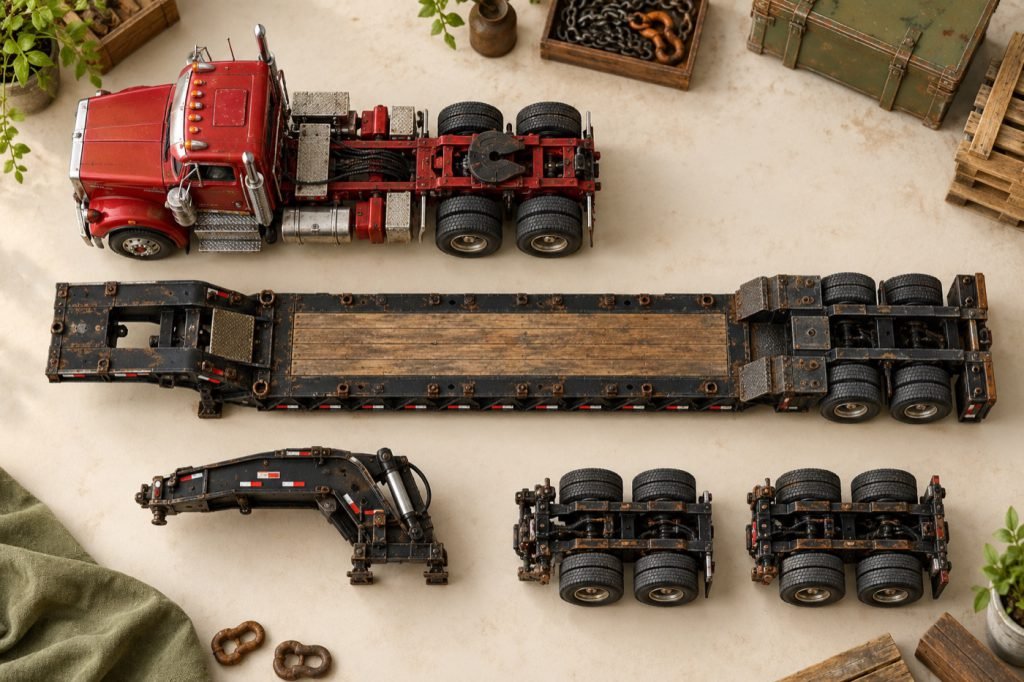
A lowboy model can change length and appearance without changing its cargo. Before comparing shelf dimensions, name the pieces in the actual arrangement. “The trailer” is too vague when optional neck and axle components are involved.
| Component | What to identify in the model record |
|---|---|
| Gooseneck | The forward trailer connection; note whether detachable and how it is shown |
| Flip neck | The optional neck arrangement described for the exact release |
| Axle booster | A rear module; record its axle count and whether fitted |
| Deck | The load platform itself, separate from the whole combination |
A record for one chosen state
The 71090 heavy-haul combination supplies single- and tandem-axle booster alternatives. Its approximate catalog length does not identify every possible arrangement. Keep “catalog length” and “my displayed configuration” as separate entries rather than replacing one with the other.
Detached does not mean it can stand alone
Check what supports a separated component before designing a detached-parts exhibit. The inspected 71090 neck lacks a drop-leg jack. Do not infer one from the fact that the neck comes off. If a stable, manufacturer-supported resting state is unverified, keep that part in its normal assembled configuration.
Keep unused pieces attributable
Photograph the complete set of loose parts before storing them. Label the storage location with the exact release code and the fitted configuration. This prevents a later sale or rearrangement from turning an unused optional module into an apparently missing part.
Cargo fit is a further decision: it needs the actual load, deck dimensions and clearances. This component record makes that later conversation precise, but does not establish load capacity or compatibility by itself.