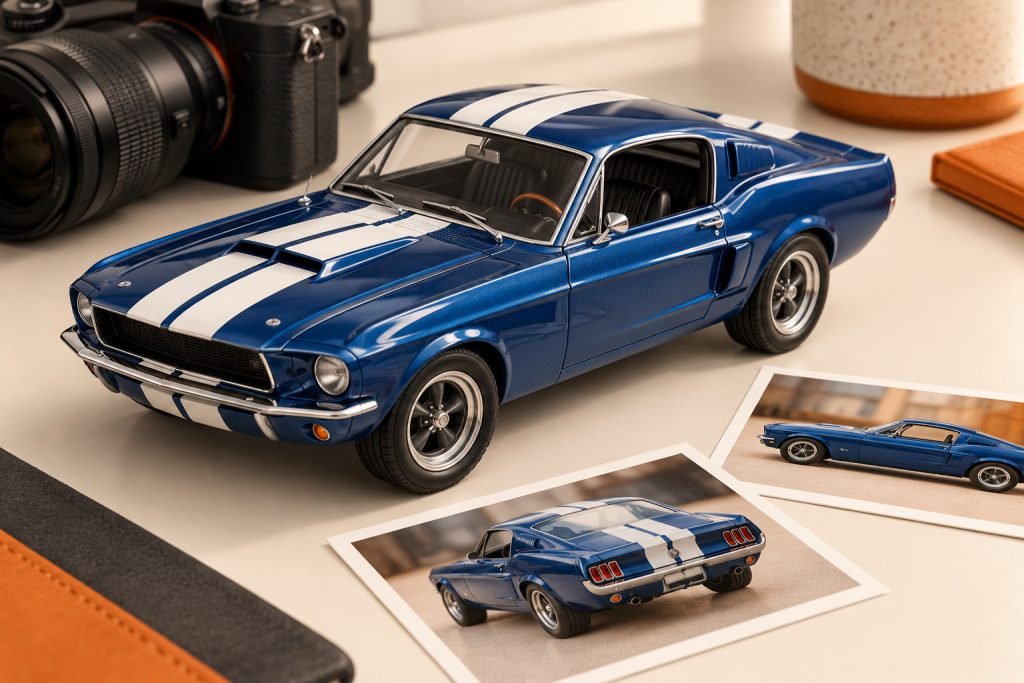
A bright line across a stripe may be glare; a blurred badge may simply be unreadable. Treat an ambiguous photograph as an unanswered question, not a diagnosis of damaged paint.
First rule out the wrong version
The Solido S1805901 listing identifies Performance Blue with white stripes. Do not use photographs of a white car with blue stripes as proof of this release’s paint application. Different decoration is a different visual check, even when the subject and scale match.
Check that the box code and photographed color agree with the offer, and distinguish catalog pictures from photographs of the actual item. Then compare equivalent angles: perspective can make a centered stripe appear uneven.
Choose the next photograph by what is unclear
- Stripe alignment: request a straight-on front or rear view, then a near-overhead view showing continuity across panels. One end does not establish the appearance of the other.
- A badge or trim break: ask for a sharp side view and a closer image of the uncertain area. Blur does not prove a missing part.
- A bright patch or suspect edge: request an angled close-up in diffuse light, with a wider image locating the area on the model.
Interpret the second image without overreaching
The mark disappears: the first image may have been misleading. Keep both views when making the decision rather than selecting the one that matches your first impression.
The mark stays visible: ask the seller to describe it and judge whether its position and appearance suit your intended viewing distance. Photographs alone do not establish a repair history.
For deliberately aged decoration, use the weathered-finish guide to separate the intended finish from the condition of the offered item.