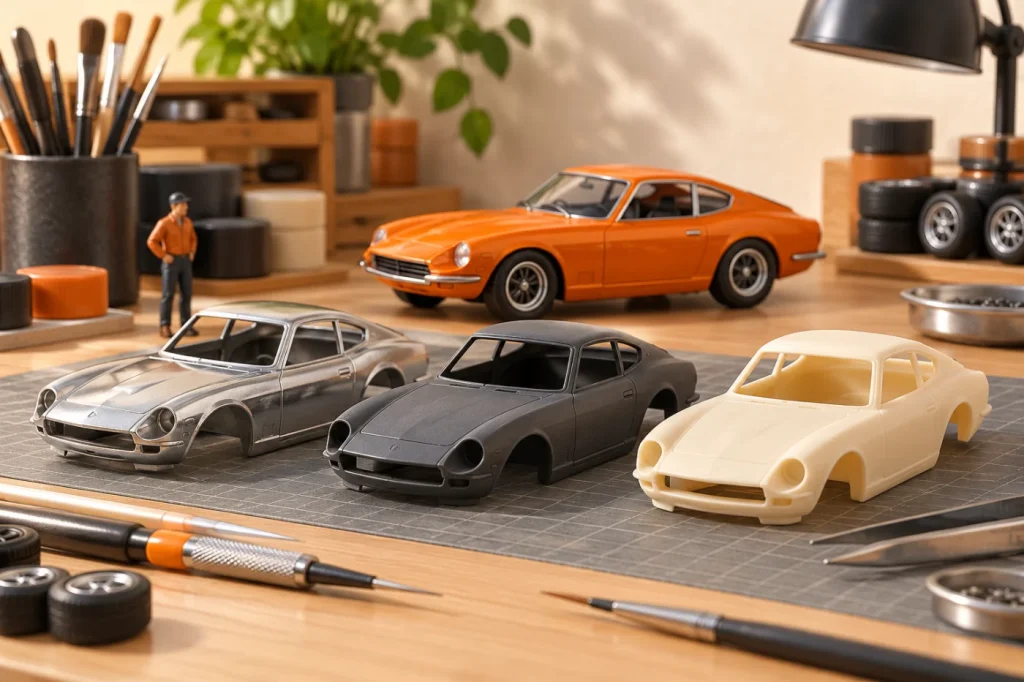
Choose a model by the features you want to see and use, then check what its body is made from. “Diecast,” “composite” and “resin” describe construction; none is a complete quality grade. A material label alone does not tell you which panels open, how well a particular sample is finished, or whether it fits your display.
What the labels tell you
| Label | What to establish | What to check separately |
|---|---|---|
| Diecast metal | Whether the body is metal and which other parts use plastic | Opening parts, detail and exact model dimensions |
| AUTOart composite | ABS composite outer body with a diecast internal structure, as described by AUTOart | The features of the exact model number |
| Resin | The material used by that manufacturer and product range | Whether the model is sealed and what is included |
Composite does not mean a resin body
AUTOart describes its composite construction as an injection-molded ABS composite body paired with a diecast interior structure. That is a specific construction system, rather than another name for a resin casting. Its 73095 Oxford White GT500 listing places that 1:18 model in the composite range.
The manufacturer also describes intended advantages of its process. Treat those as design claims, not independent proof that every sample has better paint, panel gaps or long-term durability. For a buying decision, close photographs and documented functions of the exact release are more useful than assuming the newest material must win.
Resin and sealed construction are separate questions
GT Spirit’s manufacturing explanation identifies polyurethane resin in its bodies, seats and dashboards, and plastic in components including mirrors and wheels. It also explains that its models do not open. This describes GT Spirit’s stated approach; it is not a rule that every resin model from every maker has identical construction.
If you want an engine-bay display, the absence of an opening hood is decisive regardless of how attractive the exterior looks. If you prefer a closed-car display, inspect body shape, glazing, trim and the accuracy of the depicted version. A sealed model can fit that preference without being evaluated as though it were intended for opening.
Make a feature checklist before comparing prices
- Name the exact release. Record manufacturer, model number, scale, year and color. Similar packaging or vehicle names do not establish the same casting.
- List the functions that matter. Separate doors, hood and trunk. “Opening parts” may describe only one of them.
- Check the visible details you care about. Request clear photographs of those areas. Do not infer finish consistency from a single promotional image.
- Confirm size and contents. A supplied base or cover changes the display requirement. Use the display-case measurement workflow before buying a case.
- Compare like offers. Check condition, included packaging, shipping and the final delivered price at the same time.
Which should you choose?
If a metal outer body is itself part of the collecting experience you want, verify that feature explicitly. If your priority is access to the interior, select by the documented opening functions. If the car will remain closed behind glass, focus on the exact shape, finish and version you want to display.
When two candidates use different materials, keep that difference in the comparison, but do not turn it into an unsupported reliability ranking. Pick the construction and functions that serve your collection, and leave unverified qualities unresolved.