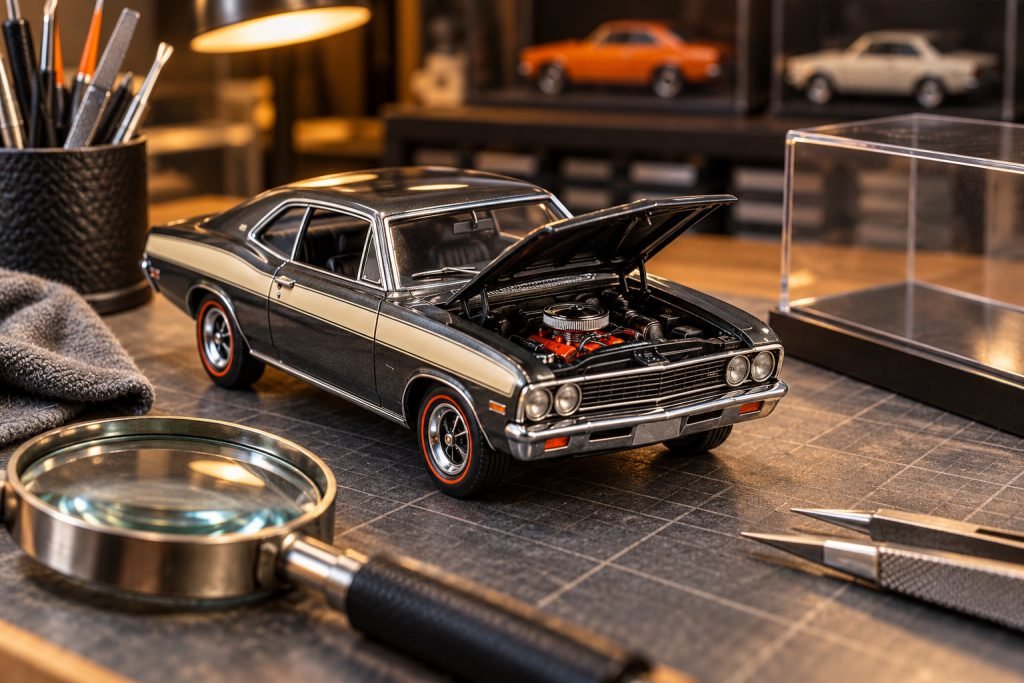
An opening hood is only the first check for an engine-focused miniature. Establish where the engine is represented, what can actually be seen, and whether the model can hold the pose you want. A full-size car’s engine specification does not tell you how its miniature engine bay is built.
Locate the engine before choosing an open pose
Location matters. The Maisto 31447r Corvette C8 listing names an opening frunk separately from the engine compartment. Do not choose a front-open pose expecting it to reveal the engine. The ACME A1806140 AAR Cuda listing instead names hood access and a wired, plumbed engine.
Use a short photo sequence
- Ask for an overall photograph with the relevant panel open, so the model’s identity and pose are visible together.
- Request an angled view into the bay, not only a directly overhead image that hides its depth.
- For a used model, ask whether the panel stays in the photographed position without a hand or temporary prop.
- If a specific cable or component matters, name it and request a closer view; do not assume every dark line is a separate part.
Separate access from detail and support
| Listing statement | What it supports | What remains unconfirmed |
|---|---|---|
| Opening hood or engine cover | A documented access feature | Range of movement and supported open position |
| Detailed engine compartment | The seller claims an engine representation | How much is separately modeled or visible from your angle |
| Wired and plumbed engine | The seller describes those details | Their placement, finish and condition on the offered example |
The AUTOart 71205 review has an exact-sample report of hood support, which is more specific than a general opening-panel claim. It still does not promise that every used example behaves the same way.
Use the display-case measuring guide once the intended pose is established.