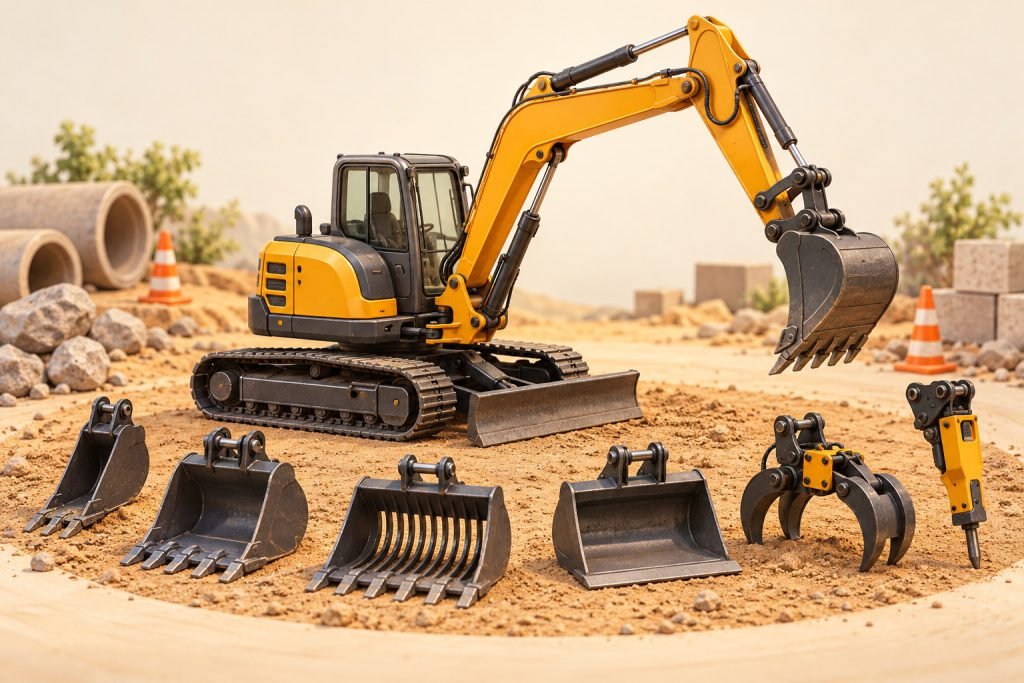
Before buying a construction miniature, separate what is modeled, what moves and what can be changed. Visible tracks, cylinders and a bucket do not establish powered movement, a particular range of motion or interchangeable attachments.
Read the model specification separately from the real machine’s story
Manufacturer literature may place full-size vehicle background beside the miniature’s item number. For example, the Diecast Masters 85959 sheet identifies a 1:50 model while also discussing Cat 395 productivity and hydraulic operating modes. Those machine descriptions are not measurements of miniature lifting performance or proof of functional hydraulics.
For the model, look for explicit statements about moving parts, materials, included tools and attachment mechanisms. Keep any unspecified feature marked unknown rather than assuming that a realistic-looking part operates.
Check tracks without assuming how they should behave
Ask whether the exact model has linked moving tracks, a fixed representation or another construction. A photograph can show their appearance but may not demonstrate movement. If free movement matters, request a demonstration of the actual model under normal handling.
When receiving a model, compare the visible track alignment and loose or missing parts against its documentation and seller photographs. If movement is not documented or a part resists, stop and ask the seller. This is an inspection workflow, not a repair or lubrication procedure.
Define what you mean by boom reach
For a display, “reach” may mean the horizontal distance from the rotating center to the tool, the model’s overall occupied length, or the height of the raised boom. These are different measurements. State the reference points and pose before comparing two figures.
Use a measured envelope of the pose you intend to display. Do not substitute full-size published reach divided by the scale unless you are explicitly making an estimate; the model’s joint limits may differ.
Verify attachment inclusion and connection separately
- Included: Does the exact item’s contents list name the tool, or is it pictured as an optional accessory?
- Changeable: Do the instructions describe a removable pin, coupler or other intended release?
- Compatible: Does the maker identify the specific attachment and model as a matched pair?
Matching color or scale answers none of those questions. Avoid pulling an attachment simply because a similar release has a quick coupler. Record the connection instructions and keep small supplied parts with the item’s packaging.
Once the pose and tool are established, use the lowboy fit checks if you intend to display the machine as a load. Keep inspection observations about your sample separate from claims about every example of that model.