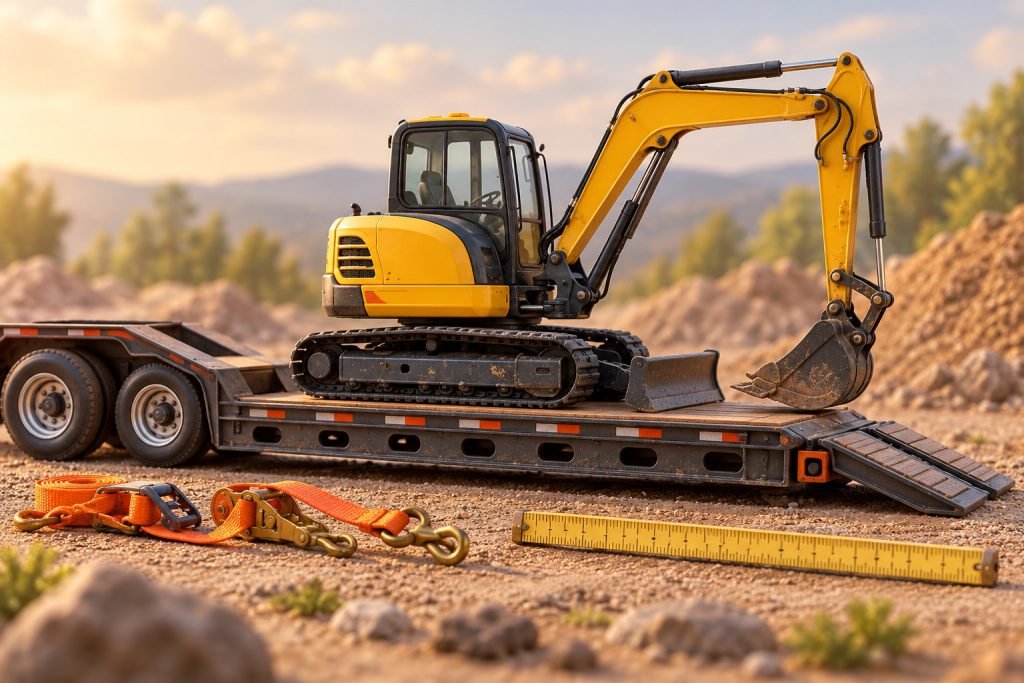
Match the excavator’s actual transport-pose footprint to the trailer’s usable deck. Equal scale labels are only the first check: a deck can be too short or narrow, and a folded boom can still conflict with the tractor or trailer structure. This guide concerns a static miniature display, not real-machine transport or load certification.
Write down both exact item numbers
Record manufacturer, scale and release code for excavator and trailer. Check whether the trailer offer includes a tractor, loading ramps, a detachable section or optional deck extensions. A photograph of a complete transport combination does not prove every item is included.
Measure the parts that actually share space
| Excavator measurement | Trailer measurement to compare |
|---|---|
| Track footprint in the planned position | Usable flat deck length and width |
| Overall folded boom and bucket envelope | Clearance around the gooseneck, tractor and rear structure |
| Height from the deck to the highest model point | Usable display-case or shelf height after allowing for deck height |
Do not compare the excavator’s overall length with the trailer’s overall length. The latter may include a gooseneck and sections that cannot support the track footprint. Keep measurements on the same basis.
The published dimensions for Diecast Masters 85586 illustrate the limitation of a simple catalog bounding box: the listing does not provide a separate track footprint or explain the boom pose. Ask for the missing measurements instead of treating the overall dimensions as a fit certificate.
Make a paper deck before assembling the display
- Draw the usable deck rectangle at actual model size.
- Draw or measure the track footprint and place it in the intended position.
- Check the boom and bucket envelope against the gooseneck, tractor and rear of the trailer.
- Measure the resulting combination’s height and total length for the shelf or case.
A hypothetical 90 mm wide track footprint on an 85 mm usable deck leaves 5 mm of total overhang. That arithmetic is not approval of the pose. Decide whether the exact model and display arrangement support what you intend, or choose a different pairing.
Stop when a connection is unverified
Do not force a gooseneck, hitch, ramp or attachment to make the scene work. A visually similar coupler is not evidence of compatibility. If the fit depends on an undocumented removable part, obtain the exact manufacturer instructions before manipulating it.
Use the 1:50 scale calculations when planning the surrounding scene, and keep the transport-fit measurements with the two item codes so a future color or tooling variant does not silently inherit the same compatibility claim.