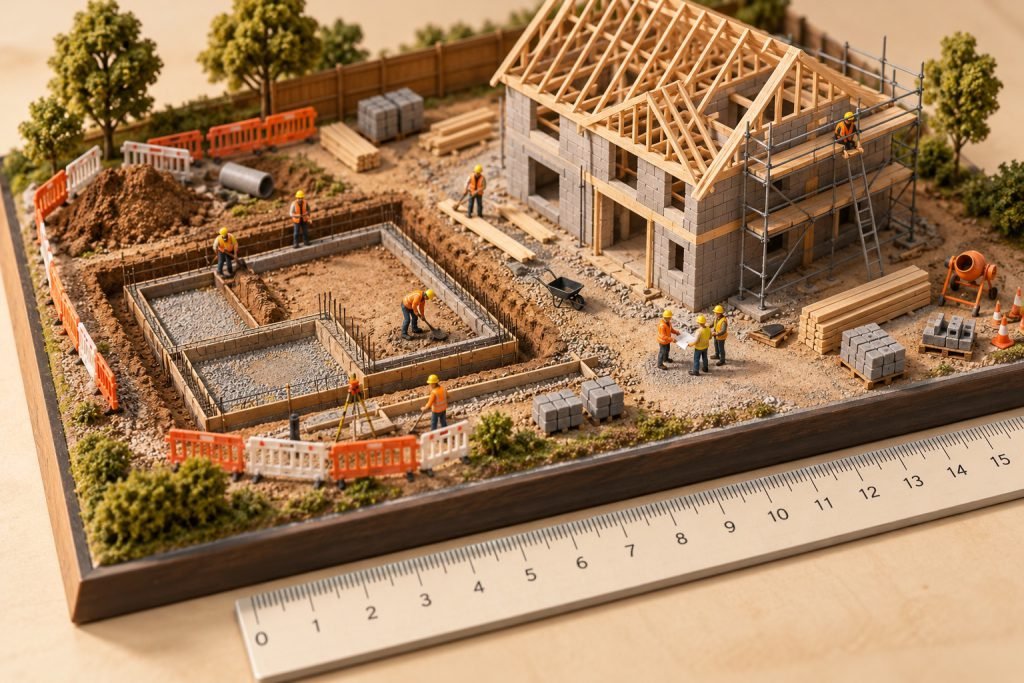
At 1:50 scale, one unit on the model represents fifty of the same unit on the full-size subject. A 5-meter dimension becomes 100 millimeters in the scene. Use that ratio to plan the ground, buildings and figures, then use actual model measurements to reserve working display space.
Convert lengths before drawing the layout
| Full-size illustrative dimension | At 1:50 | Calculation |
|---|---|---|
| 1 meter | 20 mm | 1,000 mm ÷ 50 |
| 5 meters | 100 mm | 5,000 mm ÷ 50 |
| 10 meters | 200 mm | 10,000 mm ÷ 50 |
These are arithmetic examples, not dimensions assigned to a particular excavator, lane or building. For inches, divide the full-size inch measurement by 50. To work backward, multiply a model measurement by 50. Use one unit throughout each calculation.
Scale does not specify the machine’s pose
A folded excavator and the same model with its boom extended can occupy different areas. Plan the pose you will display and measure its occupied length, width and height. Keep the path of a rotating upper body or moved attachment separate from its resting footprint.
Diecast Masters publishes dimensions for item 85586, but the short listing does not explain the measured boom pose. A catalog size can start your layout; it cannot establish an unreported maximum reach or every possible pose.
Mix scales deliberately
The same real-world object at 1:50 is 28% larger in each linear dimension than at 1:64, because 64 ÷ 50 = 1.28. At 1:87 it is smaller still. That can be noticeable when supposedly equivalent figures, doors or vehicles sit beside each other.
For a consistent scene, choose one scale for objects meant to share the same plane. If experimenting with forced perspective, place the smaller-scale subjects deliberately farther back and judge the result from the intended viewing position. Do not present a mixed-scale setup as exact dimensional realism.
Leave room to place and remove the models
Mark each model’s footprint on the base before fixing scenic elements. Add the space needed to lift it out without contacting neighboring mirrors, rails or booms. Keep that handling space distinct from the ground dimensions represented by the scene.
If the scene includes a transport combination, use the excavator-to-lowboy fit workflow to check the miniature’s actual deck fit. Matching “1:50” labels alone does not establish that a particular load fits a particular trailer.