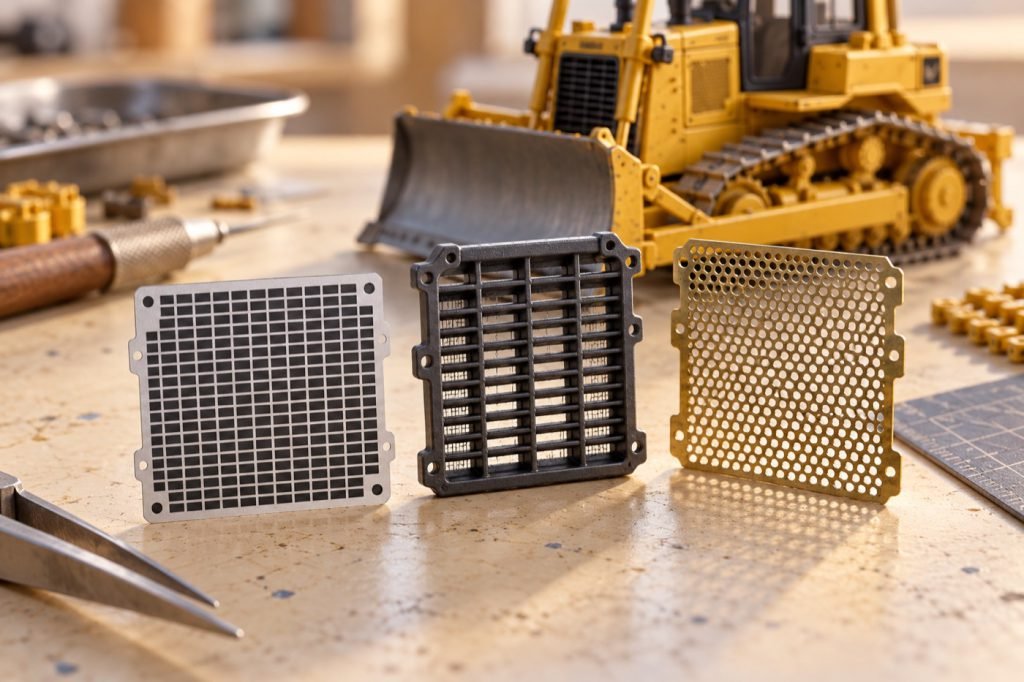
A dark square pattern is not proof that a model has an open grille. Three different treatments can produce that impression: printing on a flat surface, molded relief and actual holes. The right question is what a photograph shows, not which construction sounds most expensive.
| What you can see | What it supports | What remains uncertain |
|---|---|---|
| A grid in one straight-on image | The pattern is represented | Flat print, relief or openings may still be indistinguishable |
| Edges casting shadows in an oblique image | Surface relief | Whether the recesses go through the part |
| Background visible through repeated openings | Perforation | Material and strength |
| A uniform black area behind the grid | Very little by itself | It may be an opening, dark backing or printed surface |
Different treatments can coexist on one model
The D8 waste handler’s inspection describes a perforated plastic trash grille and graphic engine-side grilles. The D9T inspection describes a solid upper blade grille. Calling either model detailed does not tell you which of those surfaces is open.
For an ordinary shelf view, a flat graphic may communicate the surface adequately. For a photograph with light behind the blade, an open part can produce a different result. That is a reason to choose the relevant treatment, not to call every solid pattern a manufacturing fault.
See the D9T and waste-handler D8 reviews for the exact-release limits. These examples do not establish the grille construction of every model in either range.