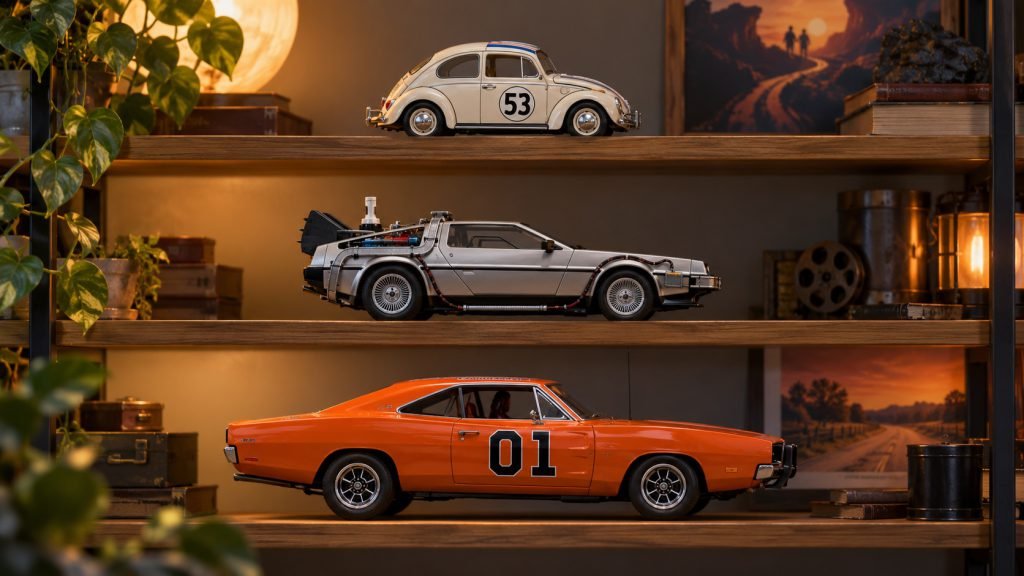
A mixed-scale collection can work as a set of film objects without pretending to be one proportionally consistent street scene. Decide which kind of display you are building before arranging the cars.
A collection shelf and a shared scene ask different things
Group by film, character or release, and label the scale. Different sizes can be intentional when each model is read as its own object.
Use a consistent intended scale and check actual proportions. Shared figures, doors and scenery make size mismatches much more conspicuous.
The catalog places Greenlight’s 13567 van at 1:18, while the Jada models in this cluster are 1:24. For the same full-size object, a 1:18 miniature would be one-third longer than a 1:24 miniature: 24 ÷ 18 = 1.333. That ratio cannot predict the lengths of a van and a different car.
Make the grouping visible before adding scenery
- Arrange temporary paper footprints using the listed dimensions as a first estimate.
- Separate scale groups with space or different display levels rather than a shared road marking.
- View the shelf from the position where it will normally be seen. Check whether the smaller model reads as distant or simply undersized.
- Add labels after the grouping works; a scale label explains a choice but cannot fix an unwanted visual imbalance.
For a single-car case, use the display-case measurement guide. It answers clearance, while this layout decision answers whether the models should share one visual space.